USA
USA Canada
What Works, What Doesn’t, and How to Get It Right
Radiant floor heating and wood flooring can work extremely well together when properly designed and installed. The result is a warm, comfortable floor with consistent, even heat throughout the space.
Because wood is a natural material, it responds to changes in temperature and humidity. That means success depends on choosing the right flooring and maintaining stable conditions.
Why Radiant Heat and Wood Flooring Work Well Together
Radiant systems heat the floor surface evenly, eliminating the hot and cold spots often associated with forced air systems. This creates a more consistent environment for wood flooring.
Benefits include:
- Even heat distribution across the entire floor
- Lower operating temperatures compared to conventional systems
- Quiet, draft-free comfort
- Reduced temperature swings within the space
When properly controlled, radiant heat provides the steady conditions that wood flooring performs best in.
Choosing the Right Wood Flooring
Not all wood flooring behaves the same under radiant heat. Selecting the right material is one of the most important decisions.
Engineered Hardwood (Best Choice)
- Designed for stability
- Less prone to expansion and contraction
- Performs well across a range of conditions
Solid Hardwood (Works with Proper Design)
- Can be used with careful species and sizing selection
- Narrower boards are generally more stable than wide planks
- Requires tighter control of temperature and humidity
Flooring to Use with Caution
- Very wide plank solid wood
- Unstable or soft species
- Products not approved for radiant applications
Always follow the flooring manufacturer’s recommendations for radiant use.
SPECIES COMPATIBILITY WITH RADIANT HEAT
Engineered Oak / Maple
96%
Engineered Walnut
88%
Narrow Solid Planks (<80mm)
74%
Click-Lock Engineered
70%
Wide Solid Planks (>120mm)
42%
Sealed Engineered Bamboo
35%
Cork Flooring
10%
Installation Considerations
Proper installation plays a major role in long-term performance.
- Install radiant panels according to the system layout
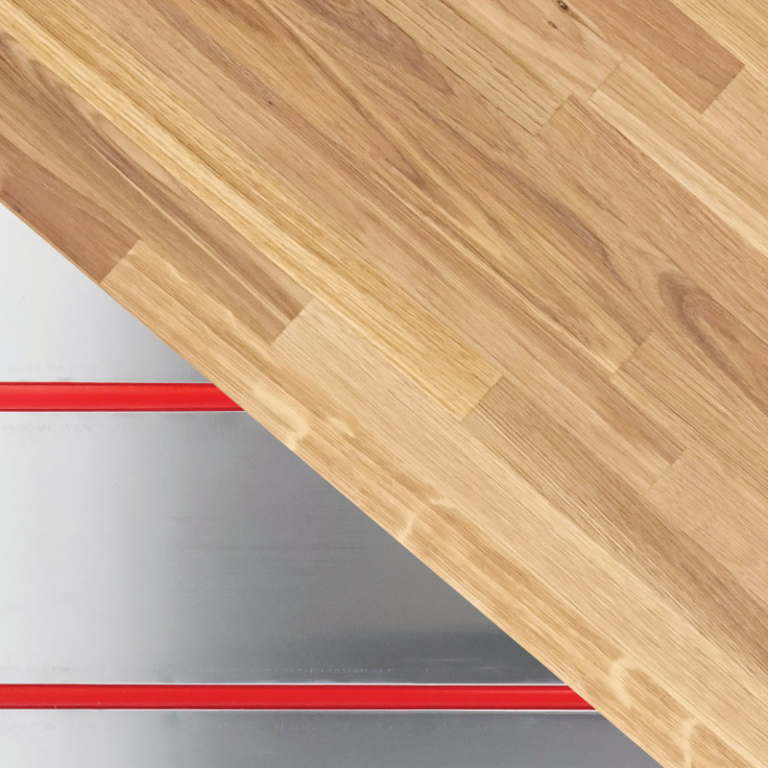
- Install wood flooring perpendicular to tubing paths when possible
- Use fasteners of appropriate length to secure into the subfloor
- Ensure consistent contact between the heating system and the floor assembly
Attention to detail during installation helps prevent movement, noise, and uneven heating.
Acclimation and System Startup
Before installation:
- Allow wood flooring to acclimate to the space
- Ensure indoor temperature and humidity are stable
After installation:
- Bring the radiant system up to temperature gradually
- Avoid rapid temperature changes
- Follow flooring manufacturer guidelines for startup
A controlled startup process helps protect the flooring from stress.
ACCLIMATION PROTOCOL — 4 PHASES
01
Deliver & Store
Day 1–2
Stack flat in the installation room. Keep sealed. Min 18°C room temperature.
02
Start Heating
Day 3–4
Run system at 18°C floor surface. Monitor room humidity — target 40–60% RH.
03
Raise Temperature
Day 5–6
Gradually increase to working temp. Check boards for cupping or gapping.
04
Verify & Install
Day 7+
Moisture content 6–9% confirmed. Install perpendicular to floor joists.
Hydronic vs Electric Radiant Systems
Both system types can be used under wood flooring, but they perform differently.
Hydronic Systems
- Provide consistent, even heat
- Operate efficiently at lower temperatures
- Well-suited for whole-room or whole-home heating
Electric Systems
- Typically used in smaller areas
- Easier to install in limited applications
- May have higher operating costs depending on usage
Hydronic systems are generally preferred for larger wood floor applications due to their ability to maintain steady conditions.
Temperature and Humidity Control
Maintaining stable conditions is essential for wood flooring over radiant heat.
Floor Temperature
- Most wood flooring manufacturers recommend a maximum surface temperature around 80 to 85°F
- Staying within this range helps prevent drying and movement
Indoor Humidity
- Maintain relative humidity typically between 30% and 50%
- Avoid large seasonal swings
- Use humidification or dehumidification as needed
Consistency is more important than hitting an exact number.
FLOOR SURFACE TEMPERATURE — SAFE OPERATING RANGE
Compatible Flooring Options
Wood flooring is not the only option over radiant heat. Other compatible materials include:
- Tile
- Luxury vinyl plank (LVP)
- Engineered wood
- Laminate
- Carpet
- Stone
Each material has different heat transfer characteristics, so system design should account for the finished floor type.
Final Thoughts
Radiant heating and wood flooring are a natural pairing when done correctly. The key is selecting the right flooring, following proper installation practices, and maintaining stable temperature and humidity levels.
Panel-based systems, such as WBI RadiantBoard and ThermalBoard, are designed to provide consistent heat distribution and controlled surface temperatures, making them a practical solution for wood flooring applications.
With the right approach, radiant heat can enhance both the comfort and longevity of wood floors.
Frequently Asked Questions
About The Author