USA
USA Canada
Choosing the Right Thermostat, Setback Strategy, and Zone Setup for Hydronic Radiant Heat
Radiant floor heating is only as good as the controls that run it. A well-designed system with poor controls delivers inconsistent temperatures and higher energy bills. The right thermostat and control strategy unlock everything radiant heat is capable of: steady comfort, efficient operation, and precise zone management.
This guide explains how radiant floor heating thermostats work, what makes them different from standard forced air thermostats, and how to set up your system for maximum comfort and efficiency.
Why Radiant Heat Needs Different Controls
A standard forced air thermostat works well because forced air systems respond quickly. The furnace fires, the blower runs, and the room temperature changes within minutes. Simple on/off control works fine in that environment.
Radiant floor heating responds more slowly, especially in concrete slab systems with significant thermal mass. The floor takes time to warm up and time to cool down. A standard thermostat that cycles the system on and off frequently causes the floor temperature to swing, which creates the uneven comfort that radiant heat is supposed to eliminate.
Good radiant controls account for this thermal lag. They anticipate temperature changes, modulate heat delivery gradually, and keep the floor at a steady temperature rather than bouncing between hot and cold.
Types of Radiant Floor Heating Thermostats
Standard Programmable Thermostats
A basic programmable thermostat works with radiant heat but requires some adjustment in how you use it. Because radiant systems respond slowly, large setback programs are not effective. For slab systems, limit overnight setbacks to 2 to 3 degrees at most. For lightweight panel systems over wood subfloors, setbacks of 4 to 5 degrees are more practical.
Radiant-Specific Thermostats
Several thermostat manufacturers offer products designed specifically for radiant applications. These include adaptive recovery, which calculates how early to start the system to reach the setpoint by the target time. They also include floor-temperature limiting, which prevents the floor surface from exceeding safe temperatures for your flooring type.
Floor temperature limiting is particularly important for hardwood and engineered wood floors. Most manufacturers specify maximum floor surface temperatures of 80 to 85 degrees F. A thermostat with a floor sensor and temperature limit protects the flooring from overheating.
Smart Thermostats
Smart thermostats like Nest and Ecobee work with hydronic radiant systems, though compatibility depends on the wiring configuration and zone valve type. Smart thermostats use learning algorithms to optimize heating schedules. For radiant systems with thermal mass, the learning period may take several weeks as the thermostat adjusts to the slower response characteristics of the floor.
Key Point: If your radiant system uses a floor temperature sensor, make sure any replacement thermostat supports dual-input control (air temperature plus floor temperature). Running radiant heat without floor temperature limiting can damage certain flooring types.
Understanding Zones
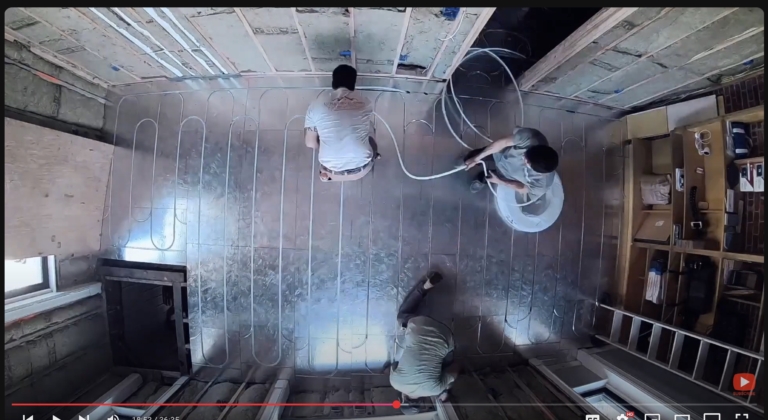
Zoning is one of the most valuable features of a hydronic radiant system. Each zone has its own thermostat and its own tubing loops, controlled independently by zone valves on the manifold. Different areas of the home can be maintained at different temperatures, heated on different schedules, or shut down entirely when not in use.
A typical residential zoning approach divides the home into areas with similar occupancy patterns. Sleeping areas form one zone, running cooler during the day and warmer at night. Main living areas form another zone. Guest rooms form their own zones and can be set to a minimum temperature without wasting energy.
How Many Zones Do You Need?
Minimum zoning separates the home into two areas: living and sleeping. This produces meaningful energy savings and improved comfort. More zones give finer control but add cost through additional zone valves, wiring, and thermostats.
A reasonable rule of thumb for new construction is one zone per 400 to 600 square feet, or one zone per distinct area with different occupancy patterns. Multi-story homes typically zone each floor separately at minimum.
Outdoor Reset Controls
An outdoor reset controller monitors the outdoor temperature and automatically adjusts the supply water temperature to match the actual heating demand.
On a cold day (0 degrees F), the system might supply water at 120 degrees F to meet peak heat loss. On a mild day (45 degrees F), the system only needs water at 80 degrees F. Outdoor reset delivers exactly the right amount of heat, reducing boiler cycling and improving efficiency.
Without outdoor reset, many systems run at a fixed, conservative supply temperature sized for peak winter conditions. On mild days, the floor overheats and the thermostat shuts the system off before it completes a full cycle. This wastes energy and reduces comfort.
Floor Temperature Sensors
A floor temperature sensor installs beneath the finished floor, typically embedded in tile grout or placed between floorboards. It gives the thermostat a direct reading of the floor surface temperature, separate from the room air temperature.
Floor sensors serve two purposes. First, they allow floor temperature limiting, which protects sensitive flooring types from overheating. Second, they enable floor-priority control, which keeps the floor at a target temperature regardless of air temperature. This is useful in bathrooms, mudrooms, or entry areas where floor warmth is the primary goal.
Not every radiant installation needs a floor sensor. Systems under tile or stone often control purely on air temperature. For systems under hardwood or engineered wood, a floor sensor and temperature limit are strongly recommended.
Practical Thermostat Settings for Radiant Heat
Keep setpoint changes gradual. Avoid large temperature swings between occupied and unoccupied modes. The floor cannot respond as fast as a furnace, and aggressive setbacks create discomfort during recovery periods.
Set the thermostat a degree or two lower than you would with forced air. Radiant-heated rooms feel warmer at the same air temperature. Start at 68 to 70 degrees F and adjust based on comfort.
Allow time for the system to stabilize before making adjustments. A new installation takes several days to reach stable floor temperatures. Judge comfort after the system has run for a full week, not after the first day.
Frequently Asked Questions About Radiant Floor Heating Thermostats
About The Author