USA
USA Canada
How Hydronic Radiant Heat Compares to Forced Air for Comfort, Efficiency, and Long-Term Value
Radiant floor heating is widely regarded as one of the most comfortable and efficient ways to heat a home. But no heating system is perfect for every situation, and radiant heat is no exception. If you are evaluating radiant floor heating for a new build, a renovation, or an addition, you deserve a clear-eyed look at both the advantages and the limitations before making a decision that will affect your home for decades.
This guide covers the real pros and cons of radiant floor heating, with particular focus on hydronic systems, which are the most practical choice for whole-home heating applications.
The Pros of Radiant Floor Heating
Exceptional Thermal Comfort
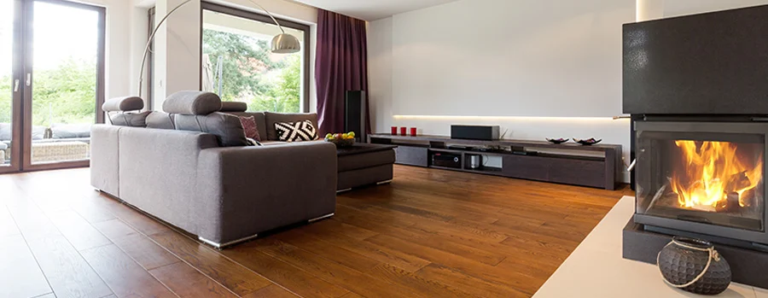
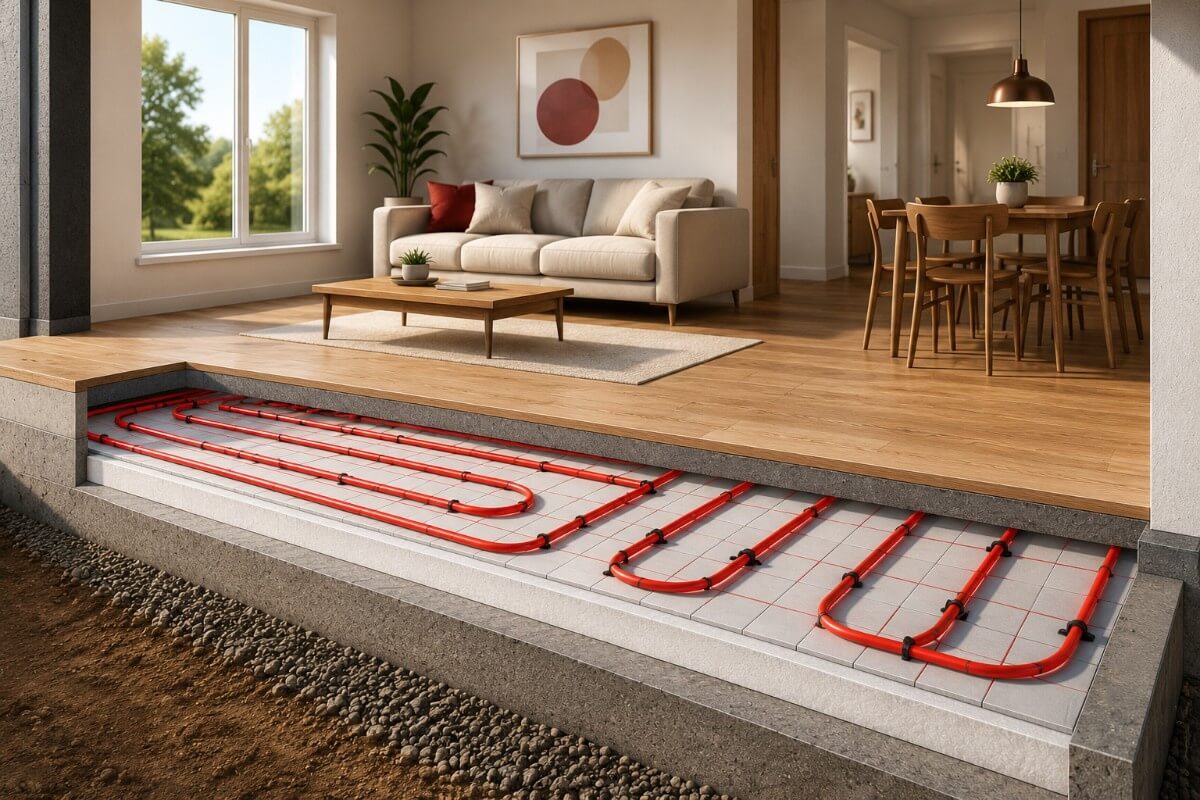
The most consistent feedback from people who live with radiant floor heating is that the comfort is unlike anything a forced air system can deliver. Heat rises from the floor, warming feet and lower body first, then radiating outward to warm all surfaces in the room. There are no cold spots near windows or exterior walls. There are no drafts from supply registers. The temperature feels stable and even because it is stable and even.
This comfort advantage comes from the way radiant heat works. Rather than heating air, which stratifies and leaves the floor cold, a radiant floor warms the entire room from the ground up. Research on thermal comfort consistently shows that people feel comfortable at lower air temperatures in a radiant-heated space, typically 2 to 4 degrees Fahrenheit lower than in a forced air space. That difference has real energy consequences over a heating season.
Better Energy Efficiency
Hydronic radiant floor systems operate at water temperatures between 80 and 120 degrees Fahrenheit, far lower than the 160 to 180 degrees typical of baseboard systems. This lower operating temperature allows the system to pair efficiently with condensing boilers and air-to-water heat pumps, both of which deliver their best performance at low supply temperatures.
Beyond the heat source efficiency, radiant systems eliminate the energy losses associated with forced air ductwork. Studies by the U.S. Department of Energy have found that duct systems can lose 25 to 40 percent of heating energy to leakage and conduction through unconditioned spaces. A hydronic radiant system has no ducts. All of the energy that enters the system goes into the floor and then into the room.
The lower air temperature at which people feel comfortable in a radiant-heated space also reduces infiltration losses, since the temperature difference between inside and outside is smaller. All of these factors combine to make a well-designed hydronic radiant system meaningfully more efficient than a comparable forced air system in most climates.
No Noise, No Drafts, No Dust
Forced air heating systems are inherently noisy. The blower runs, air pushes through ducts, and registers create a constant background noise that most people have simply learned to ignore. Radiant floor systems have no blower. A circulator pump moves water silently through the tubing, and the floor does the rest. The result is a completely quiet environment.
Because radiant systems do not move air to distribute heat, they also do not circulate dust, pet dander, pollen, or other airborne particles. This is a meaningful quality of life improvement for anyone who suffers from allergies or respiratory sensitivities. It also means less dust settling on surfaces throughout the home.
Design Freedom and Space Savings
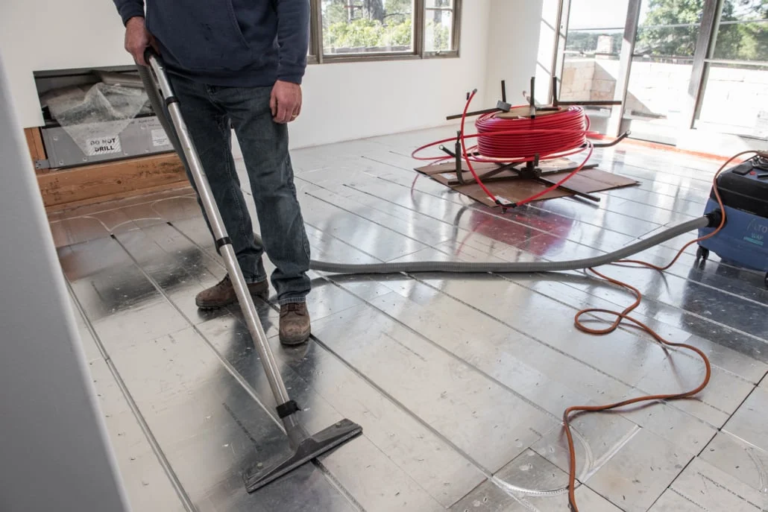
Radiant floor heating frees up wall space that would otherwise be occupied by baseboards, registers, or radiators. This matters for furniture placement, especially in rooms where wall space is at a premium. There are no supply or return registers to work around. No ductwork runs through walls, ceilings, or closets. The mechanical footprint of a hydronic radiant system is limited to the boiler or heat pump, the manifold, and the tubing beneath the floor.
This design freedom is one reason radiant heat is popular with architects designing high-end custom homes, where every square foot of wall and floor space is considered intentionally.
Compatible With Renewable Energy Sources
Because hydronic radiant systems operate at low water temperatures, they are well matched with heat pumps, which are most efficient when the temperature difference between source and output is small. An air-to-water heat pump connected to a hydronic radiant system can achieve coefficient of performance values of 3.0 to 5.0 or higher in moderate climates, meaning it delivers three to five times more heat energy than the electrical energy it consumes.
Solar thermal panels can also supplement or fully supply the heating load in favorable climates. The combination of radiant distribution with renewable heat sources creates one of the most sustainable heating configurations available in residential construction today.
Durability and Low Maintenance
PEX tubing installed in a properly designed hydronic radiant system has a rated service life of 50 years or more. Once installed, there is nothing in the floor to fail. The boiler and circulator pump require periodic maintenance, but the distribution system itself is essentially maintenance-free. There are no filters to change, no ducts to clean, no registers to repair.
This longevity makes radiant heat a sound long-term investment in the structure of a home. Unlike a forced air system, which typically requires major equipment replacement every 15 to 20 years, a hydronic radiant system installed today should outlast most of the other mechanical systems in the building.
The Cons of Radiant Floor Heating
The Upfront Cost Is Higher, But So Is the Return
Installing a hydronic radiant system does cost more upfront than a forced air furnace and ductwork. A realistic estimate for a whole-home hydronic radiant system runs 30 to 60 percent higher than a comparable forced air installation, depending on home size, substrate, and heat source selection.
What that number does not capture is what you get for the difference. The distribution system, meaning the PEX tubing beneath the floor, carries a rated service life of 50 years or more. The operating costs are lower. The maintenance requirements are minimal. When you look at total cost of ownership over 20 to 30 years rather than just installation day, the gap between radiant and forced air narrows considerably, and in many cases radiant comes out ahead. The upfront cost is real, but it is an investment, not just an expense.
Slab Systems Respond Slowly, and That Is Actually a Feature
Concrete slab radiant systems have significant thermal mass, which means they take time to heat up after a cold start. A slab that has cooled overnight may take several hours to bring the space back to full comfort temperature. If your first instinct is that this sounds like a problem, it helps to understand why it happens.
That thermal mass is also what makes slab systems so stable. Once the slab reaches operating temperature, it holds heat for a long time, even after the boiler cycles off. Temperature swings are minimal. The system runs less frequently. Energy use stays consistent. For most whole-home applications, the warmup lag is managed with smart thermostats and mild overnight setbacks rather than aggressive temperature drops.
For projects where faster response is a priority, lightweight panel systems like ThermalBoard or RadiantBoard installed over wood subfloors respond in 30 to 60 minutes and work well with programmable zone control. The right system type depends on the application, and both options have genuine advantages.
Radiant Does Not Cool, But It Pairs Well With Systems That Do
Radiant floor heating is a heating system, and in climates with significant cooling loads, a separate cooling solution is still needed. That said, because radiant heat is so efficient at conditioning the space, the cooling system does not need to work as hard. Many homeowners in mixed climates pair radiant floors with a compact mini-split system for cooling, ending up with a setup that handles both seasons more efficiently than a combined forced air system would.
Radiant ceiling cooling is also a real option in certain commercial and high-end residential applications, though it requires careful humidity management to prevent condensation. For most homes, the answer is that radiant heat covers winter exceptionally well, and a well-chosen cooling partner handles summer.
Most Floor Coverings Work Beautifully, With One Exception to Plan Around
Tile, stone, engineered hardwood, luxury vinyl plank, laminate, and carpet all perform well over radiant heat. The compatibility is broad, and most homeowners can choose flooring freely without concern.
The one material that needs extra thought is solid hardwood. Because solid wood moves with changes in moisture content, the heat from a radiant floor needs to be managed carefully to prevent gapping or cupping. It is entirely doable with the right species, proper acclimation, and controlled operating temperatures, but it requires more planning than other flooring choices. If solid hardwood is a priority, discuss it with your radiant contractor during the design phase rather than after the floor goes in.
Good Design Is Non-Negotiable, Which Keeps Quality High
A hydronic radiant system that is properly designed performs beautifully for decades. One that is undersized, incorrectly zoned, or paired with the wrong controls will underperform and be difficult to correct after the floor is finished. This means the quality of your contractor and your panel system matters more with radiant heat than it does with a forced air furnace.
This is actually a good thing for homeowners who do their homework. Working with an experienced radiant contractor, using engineered panel systems that have documented thermal performance, and specifying proper controls from the start virtually guarantees a system that delivers everything radiant heat is capable of. The design requirement is not a hidden risk; it is a quality filter that rewards thoughtful planning.
Is Radiant Floor Heating Worth It?
For most homeowners who are building new or undertaking a significant renovation, the answer is yes, with qualifications.
Radiant floor heating delivers a level of thermal comfort that no forced air system can match. It is quiet, clean, and highly efficient when paired with the right heat source. The operating cost savings are real and compound over time. The durability of the distribution system means it is unlikely to need replacement during the life of the building.
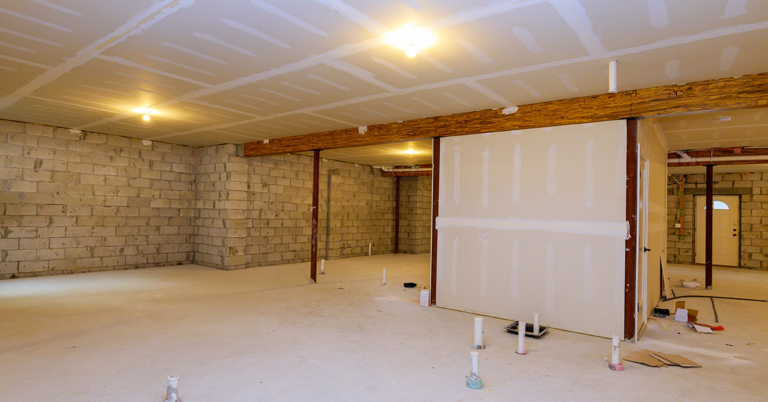
The case for radiant is strongest in new construction, where the installation cost difference is smallest because there is no finished floor to remove and replace. It is also strong in climates with long heating seasons, where the efficiency advantage has more time each year to offset the higher installation cost.
The case is weaker for small supplemental heating applications, where electric radiant mats may be a simpler and more cost-effective solution. It is also weaker for projects with very tight budgets, where the upfront cost difference is a genuine barrier even when the long-term economics favor radiant.
If comfort, efficiency, and long-term value matter to you, radiant floor heating is worth the investment. Understanding both the advantages and the real limitations up front is the best way to make a confident decision and end up with a system that performs exactly as expected for decades.
Frequently Asked Questions About Radiant Floor Heating Pros and Cons
Have questions about your radiant heating project? Meet the WBI team.
About The Author