USA
USA Canada
Radiant Heat Installation: A Complete Guide for Homeowners and Contractors

Radiant heat installation is rapidly becoming one of the preferred heating solutions for new homes, remodels, and high performance construction. The combination of comfort, efficiency, and quiet operation makes radiant heating a strong alternative to forced air systems. Whether you are a contractor planning a project or a homeowner evaluating options, understanding how radiant heat installation works is essential.
Radiant heat is especially powerful when integrated with modern low temperature equipment such as air to water heat pumps and high efficiency condensing boilers, both of which achieve peak performance when paired with radiant floor systems designed to run at low water temperatures. High quality radiant panels, such as WBI’s Radiantboard and Thermalboard systems, make this possible by improving heat transfer and reducing downward heat loss.
This guide explains how radiant heat installation works, which methods are most efficient, and why properly designed radiant systems can dramatically improve comfort and reduce energy bills.
What Is Radiant Heat Installation
Radiant heat installation involves placing warm water PEX tubing or electric heating elements beneath the floor surface so heat can transfer upward into the living space. Hydronic radiant heating is the standard choice for whole home applications because it is more efficient, more controllable, and better suited for larger areas than electric systems.
Hydronic systems circulate warm water supplied by heat pumps or condensing boilers, making them efficient even in cold climates.
Types of Radiant Heat Installation
There are several radiant installation methods, each suited to different project types.
1. Concrete Slab Radiant Heating
This method installs PEX tubing directly into a concrete slab.
Advantages:
- Very consistent heat output
- High thermal mass
- Ideal for basements and slab on grade homes
Limitations:
- Slow response time
- Height cannot be modified
- Requires proper insulation below
2. Gypsum Pours Over Framed Floors
Tubing is installed over the subfloor and covered with a gypsum based leveling pour.
Advantages:
- Creates smooth thermal mass
- Works very well under tile and stone
- Predictable heat distribution
Limitations:
- Adds weight to the structure
- Adds height to the assembly
- Requires cure time that can delay construction
3. Above Floor Radiant Panel Systems
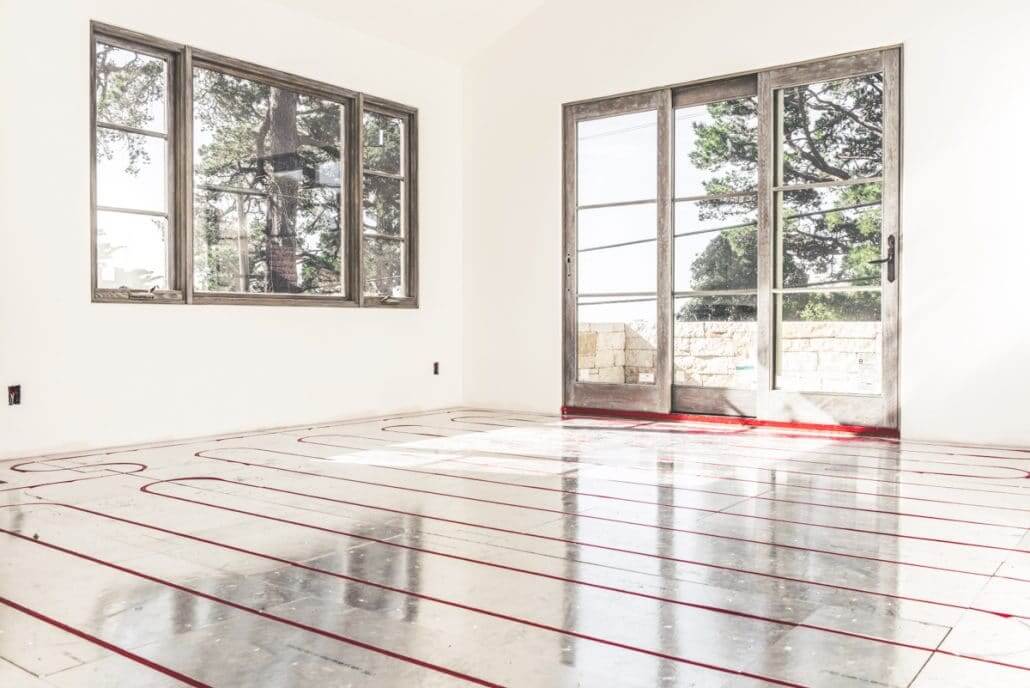
Panel based radiant systems are quickly becoming the preferred method among contractors because they are lightweight, fast to install, and optimized for low water temperatures.
WBI’s Radiantboard, Thermalboard, Radiantboard EPS, and Thermalboard EPS offer high efficiency heat transfer using integrated aluminum and grooved channels for PEX tubing. EPS backed versions reduce downward heat loss and further improve system performance.
Advantages:
- Very fast to install
- No drying time
- High output at low water temperatures
- Low profile assembly compatible with most flooring types
- Ideal for heat pumps and condensing boilers
- Excellent controllability and fast warm up
Limitations:
- Requires proper layout planning
- Slight cost premium over underfloor methods
4. Staple Up Underfloor Systems
PEX tubing is stapled to the underside of the subfloor.
Advantages:
- Works for retrofit applications
- No modification to finished flooring
Limitations:
- Lower efficiency without aluminum plates
- Requires strong insulation beneath
- Often requires higher water temperatures than panel systems
Key Steps in Radiant Heat Installation

Understanding the installation sequence helps both contractors and homeowners visualize the full process.
1. Heat Load and System Design
Everything starts with a proper heat loss calculation. This determines:
- Tube spacing
- Required water temperature
- Panel selection
- Manifold placement
- Loop lengths
- Control strategies
Low water temperature design is essential when pairing with air to water heat pumps or condensing boilers. Both deliver their highest efficiency when water temperatures remain in the low range, typically 85 to 120 degrees depending on floor covering and climate.
Radiant panel systems like WBI Radiantboard make this easier by improving heat transfer so lower supply temperatures can still meet design load.
2. Preparing the Subfloor
Contractors inspect for:
- Flatness
- Moisture issues
- Structural soundness
- Proper insulation
EPS backed panels, such as WBI Radiantboard EPS and Thermalboard EPS, integrate insulation directly into the heating layer and help control downward heat loss.
3. Installing Panels, Slab Prep, or Gypsum Prep
This step depends on the selected method:
- Placing radiant panels and securing them to the subfloor
- Installing mesh and tubing for slab setups
- Preparing for gypsum pours
- Routing for manifolds
Panel systems install very quickly using standard carpentry tools, making them ideal for projects with tight schedules.
4. PEX Tubing Installation
PEX is placed into panel grooves or attached to mesh or the underside of the subfloor.
Key considerations include:
- Following bend radius guidelines
- Keeping loop lengths consistent
- Avoiding kinks
- Fully seating tubing in panel grooves
- Securing tubing at manifold connections
Radiant panels simplify this step because grooves lock tubing into place at exact spacing.
5. Pressure Testing
Before flooring goes down, installers perform:
- 24 hour pressure test
- Loop verification
- Leak testing
- Balancing flows
This ensures the system is watertight and ready for coverage.
6. Installing Finish Flooring
Different floor coverings influence radiant performance.
Compatible options include:
- Tile and stone
- Thin hardwood
- Engineered wood
- Luxury vinyl
- Carpet with radiant approved underlayment
Panel systems help maintain even temperatures across all flooring types by spreading heat through the integrated aluminum layer.
7. System Start Up and Commissioning
This includes:
- Purging air from loops
- Testing circulators
- Dialing in water temperatures
- Setting thermostats and control logic
- Verifying warm up and cool down patterns
Heat pumps and condensing boilers both require proper commissioning to ensure stable, low temperature operation.
Why Low Water Temperature Matters
Modern heating equipment performs best at low water temperatures.
Air to Water Heat Pumps
These systems reach peak efficiency when supply water stays between 85 and 120 degrees. Radiant panels enable these lower temperatures by maximizing heat transfer.
Condensing Boilers
Condensing boilers achieve their highest AFUE ratings only when return water stays cool enough for flue gas condensation to occur. Radiant heating is one of the few distribution methods that consistently maintains these low return temperatures, especially when paired with high performance radiant panels.
Because radiant floors run cooler than baseboard, radiators, or fan coils, they unlock the full efficiency potential of both heat pumps and condensing boilers.
Where WBI Products Fit Into Radiant Installation
WBI’s radiant panel systems play an important role in creating high efficiency assemblies:
Radiantboard and Thermalboard systems offer:
- Integrated aluminum for superior heat transfer
- Lower required supply water temperatures
- High output even under challenging floor coverings
- Faster warm up times
- EPS backed options for insulation and reduced heat loss
- Straight and combo boards for easy room layouts
These benefits help achieve stable, energy efficient radiant systems that operate perfectly with heat pumps and condensing boilers.
Conclusion
Radiant heat installation offers unmatched comfort, high efficiency, and strong compatibility with modern heating technologies. Whether installed in slabs, gypsum pours, or above floor radiant panels, hydronic radiant systems provide a level of comfort that homeowners immediately appreciate.
When combined with low temperature sources like air to water heat pumps and condensing boilers, radiant systems become one of the most efficient heating solutions on the market. High performance panels such as WBI Radiantboard, Thermalboard, and EPS backed options further enhance efficiency by improving heat transfer, lowering supply temperatures, and simplifying installation.
About The Author

![Optional-PEX-Tubing[1]](https://wbiwarm.com/wp-content/uploads/2024/12/Optional-PEX-Tubing1-768x512.png)