USA
USA Canada
Hydronic radiant wall heating panels have a long and well-documented track record in Europe, where they are a standard feature in high-performance buildings across Germany, Austria, Scandinavia, and the UK. In North America, they remain one of the most underused heating technologies available, largely because the industry standardized on forced-air distribution during the post-war construction boom. Contractors trained on ductwork rarely encountered hydronic wall panels, and the technology never reached the mainstream.
That gap represents an opportunity. For retrofit projects, additions, rooms where floor heating is not practical, and homes making the switch from fossil fuel furnaces to heat pumps, hydronic radiant wall panels offer a level of comfort and efficiency that forced-air systems cannot match. WBI has been supplying these systems to North American contractors for decades. Here is what makes them work, and when to use them.
How Hydronic Radiant Wall Heating Panels Work
Hydronic radiant wall panels circulate hot water from a boiler or heat pump through tubing embedded in or attached to a wall-mounted panel. The water warms the panel surface, and that surface emits infrared energy into the room. People and objects in the room absorb that energy directly as warmth, independent of the air temperature.
Unlike a cast-iron radiator, which heats primarily through convection and must reach high surface temperatures to move adequate heat into the room, a properly designed radiant wall panel covers enough surface area to deliver the room’s full heating load at relatively low temperatures. A panel operating at 110 degrees Fahrenheit surface temperature feels warm to the touch but not hot, and it heats the room gently and evenly without the air disturbance that forces dust and allergens into circulation.
The absence of air movement is what most homeowners notice first. There is no blower, no cycling noise, no draft from a register, and no cold pocket near the floor where the heating system is not reaching. The room simply stays at a consistent temperature from floor to ceiling, and the warmth feels like sunlight rather than a furnace.
Why Low Water Temperature Is the Key Advantage
The most important technical characteristic of WBI’s hydronic wall panels is their ability to deliver full comfort output at supply water temperatures of 100 to 120 degrees Fahrenheit. This is far below the 160 to 200 degrees required by older cast-iron radiator systems and well within the optimal operating range of modern condensing boilers and heat pumps.
For heat pumps, this matters enormously. A heat pump’s coefficient of performance, the ratio of heat output to electricity consumed, drops as the required delivery temperature rises. At 120 degree supply water, a modern heat pump might deliver a COP of 3.5, meaning 3.5 units of heat for every unit of electricity consumed. At 160 degrees, the same heat pump might deliver a COP of 2.0 or less. The lower the temperature the distribution system requires, the more efficiently the heat pump operates, and the lower the operating cost over the life of the system.
Condensing gas boilers show the same sensitivity. A condensing boiler recovers latent heat from flue gases only when the return water is cool enough to condense water vapor. Systems that return water at 110 to 115 degrees trigger condensing operation reliably, which pushes seasonal efficiency above 90 percent. Systems returning water at 140 degrees often fail to condense and operate at the same efficiency as a non-condensing boiler.
Hydronic Wall Panels vs Traditional Radiators
The confusion between hydronic radiant wall panels and traditional panel radiators is common and worth addressing directly. Both move hot water through a wall-mounted unit. The design philosophy and operating parameters are different.
A panel radiator is optimized for rapid heat output at high water temperatures. It is lightweight, heats quickly, and cools quickly, which makes it well-suited to older systems that require high-temperature water. Most of its output is convective: the hot surface heats the adjacent air, which rises and circulates through the room. This produces faster response but less uniform comfort than a true radiant panel.
WBI’s hydronic radiant wall panels are designed with larger surface areas and lower operating temperatures. They emit a higher proportion of their output as infrared radiation, which heats objects and people directly rather than heating the air first. The room responds more slowly to thermostat changes, which is why these systems perform best when run at a steady setpoint rather than set back aggressively. For a home that is occupied most of the day, this operating strategy costs less and feels better than a high-temperature system cycling on and off.
Where Hydronic Wall Panels Belong in a System Design
WBI’s approach to whole-house radiant heating starts with floor panels wherever the floor assembly allows it. Floor heating is the most comfortable placement for a radiant source, and it works well with every flooring material from tile to engineered hardwood. Wall panels take over where floor panels are not an option.
Common situations that call for wall panels include: retrofit projects with inaccessible subfloor assemblies, rooms with structural concrete floors, historic renovations with protected floor materials, additions connected to an existing hydronic system, and rooms with very high ceilings where supplemental wall-level heating improves the distribution of warmth across the occupied zone.
In all of these cases, the wall panels connect to the same boiler or heat pump as any floor panels in the system. Zone valves and thermostats control each area independently. The homeowner experiences a building that is warm and consistent throughout, without knowing or caring which rooms are using floor panels and which are using wall panels. The system does its job invisibly, and that invisibility is the point.
Installation: New Construction and Retrofit
In new construction, WBI wall panels can be integrated into the wall assembly before the finish surface goes up. Tubing runs behind drywall or plaster, the panel surface is the finished wall, and there is no visible equipment in the room at all. This approach works particularly well in high-end residential projects where the absence of visible mechanical equipment is part of the design brief.
In retrofit installations, WBI’s surface-mount panels attach to the existing wall with minimal preparation. Supply and return connections run at baseboard level, the panel mounts flush to the wall, and the installation is complete. The process is far less disruptive than replacing a forced-air system, which requires ductwork modifications, new registers, and in many cases structural work to route ducts through finished ceilings and floors.
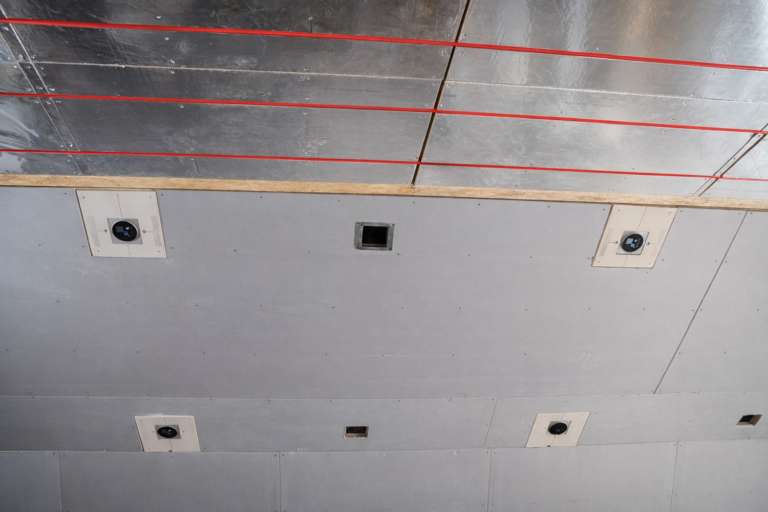
Insulating the wall behind any panel installation is essential. Without it, the panel loses a significant portion of its output through the exterior or into an unconditioned adjacent space. WBI specifies insulation requirements for every installation as part of the system design, and contractors are guided through the calculation during the project scoping process.
Frequently Asked Questions About Hydronic Radiant Wall Heating Panels
Talk to WBI About Hydronic Wall Heating for Your Project
WBI has been supplying hydronic radiant panel systems to contractors and homeowners across North America for decades. Tell us about your project and we will help you design the right system.
About The Author